Friday, February 15, 2013

Rio

We are back on the ship after a little side trip off the ship to Iguazu Falls.  It will take a bit to get caught up on this blog.  I’m afraid the photos will be limited as we did not get additional free internet minutes when the second leg of this cruise started and they take up a lot of minutes to upload.  On a previous B2B (back-to-back) cruise we received a whole new set of minutes with the 2nd leg but I guess it depends on the ship’s internet manager.

 Rio de Janeiro (River of January) is commonly referred to simply as Rio. It is the capital city of the State of Rio de Janeiro and is the second largest city in Brazil. It was the capital of Brazil for nearly two centuries, from 1763 to 1815 during the Portuguese colonial era and from 1822 to 1960 as an independent nation. Rio is nicknamed A Cidade Maravilhosa (The Marvelous City). Rio de Janeiro is famous for its natural settings, its carnival celebrations, samba, Bossa Nova and hotel -lined tourist beaches, such as Copacabana, Ipanema and Leblon. Two of its most famous landmarks in addition to the beaches are the giant statue of Christ, known as Christ the Redeemer ('Cristo Redentor') atop Corcovado Mountain and Sugarloaf mountain (Pão de Açúcar) with its cable car. The population of the city which occupies an area of 456.5 sq miles is about 6,100,000. The population of the greater metropolitan area is estimated at 11 to 13.5 million. Residents of the city are known as Cariocas. Rio de Ja-neiro is home to the largest Portuguese population outside of Lisbon in Portugal.
The ship overnights here in Rio but since our plans were to leave the ship on day 2 and fly to Iguazu Falls, we had a whirlwind 8-hour tour to try to see as much as possible in a short time.  Being part of a small private tour enabled us to accomplish our wish of seeing Christ the Redeemer and Sugar Loaf in spite of immense crowds and intense heat and humidity.


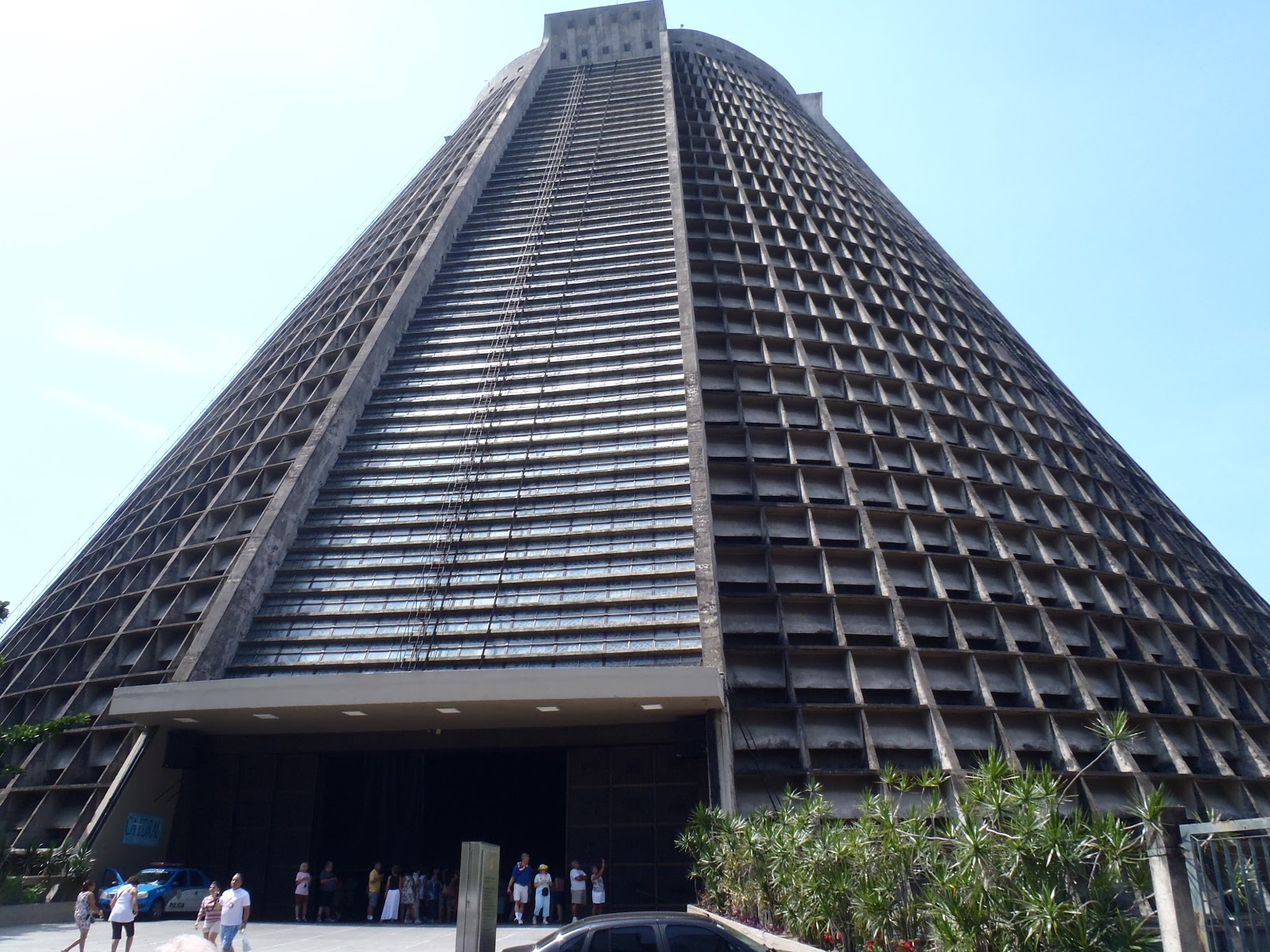
Our first stop was at the Grupo Coracao Divino De Jesus church.  It looks like a pyramid with a flat top on the outside.  Inside there is the most beautiful stained glass windows that stretch all the way to the ceiling.


The classic tourist photo pose

One of the view decks at Christ the Redeemer
We then headed to Corcovado Mountain where we had timed tickets to view the Art-deco style Christ the Redeemer statue.  The timed tickets worked out well as we were headed up the mountain on the train just 18 minutes after our time window.  Once we disembarked the electric rail train, we climbed 220 steps to the base of the statue.  It was awesome.  The crowds were huge and we had to elbow our way to the viewing platform to get a magnificent view.  The sun was behind the statue so it wasn’t the best time of the day to photograph it.

The 125-foot statue of Christ the Redeemer, now named as one of the New Seven Wonders of the World, can be used as a navigation mark. It sits on Corcovado Mountain, which at 2,330 feet, is the highest point of this massive city.


Another icon that is famous in Rio, is Sugar Loaf Mountain, 1,300 feet high.  It got its name as it resembles the sugarcane buildings used to process sugar.  A ride in the gondola up to the top provided us with stunning views of Rio and its famous white sand beaches, Copacabana and Ipanema Beaches. We didn’t have time to actually visit the beaches.
Again it was very, very crowded.  We knew to expect this in Rio, and especially at Carnaval time.  We ran out of tour time and headed back to the ship.  We had another tour planned for the evening hours so we anxiously watched the time as the bus crawled through the Rio traffic.
Once back at the port, we found our daily runs to be beneficial as we needed to run the half mile down the dock to reach our ship.  We arrived at 7:31 pm and thought we could clean up, relax a bit and have something to eat before meeting up with our “Rio Nite” group in 45 minutes.  WRONG!  At 7:43 our group leader called our room and said we needed to be downstairs in 2 minutes!  During our time back on the ship we only had time to shower and change clothes.  We grabbed a Panini from the International Café on the way off the ship and away we went to experience a little bit of Rio Carnaval at night.
We did not have tickets to the famous Sambadome where Samba School dancers compete.  Tickets inside to see the schools perform cost about $400 per person; $700 if you took the ship’s excursion.  We just couldn’t opt for that.  So instead, our guide took us to the staging area for the schools where they assemble in preparation to perform in the Sambadome.  We walked around the outside and just people watched.  We went into a building that had bands playing and people samba dancing.  Our friendly, young guide, Marconi, saw to it that we got out onto the floor and danced!  He said, “To samba dance, just stomp your foot like you are killing a cockroach, then squish it, and shake your bottom.”  It was fun.

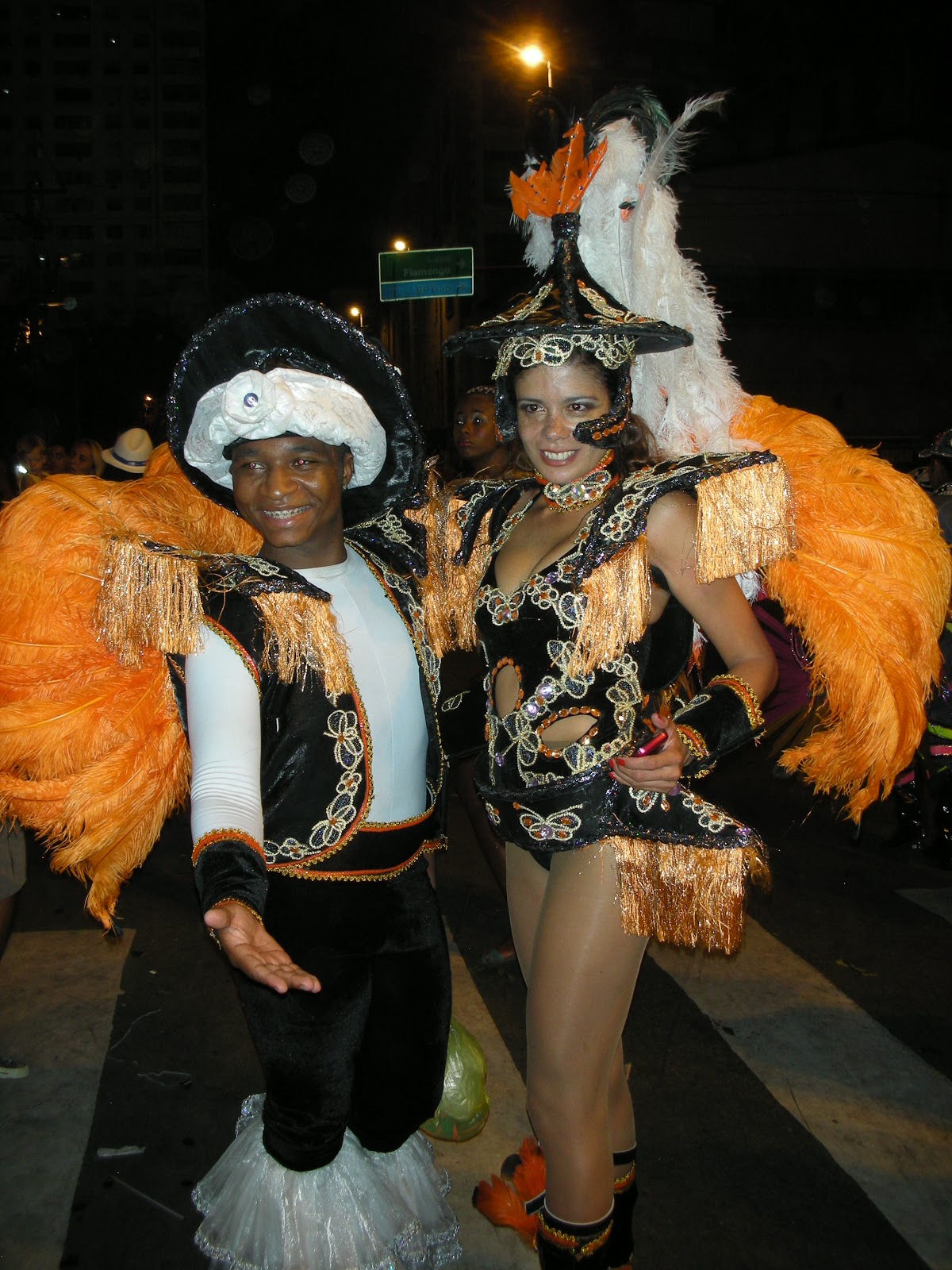
Our tour group and the Princess of Portugal


Back outside the Sambadome, we watched the dancers leave after their competition.  They were more than happy to stop and pose for a photo.  In fact, everyone was very happy and having a great time.
Our heads hit the pillows that night at about 2:00 am.  Exhausted, but glad we were able to experience a little bit of Rio at Carnaval time.
The next morning we left the ship and flew to Iguazu Falls.

Friday, February 8, 2013

Salvador, Brazil


When it comes to Salvador, think Africa in South America, but with a Portuguese flavor.  Salvador was Brazil’s main seaport during the active Brazilian slave trading era (16th and 17th centuries).  After the slaves were freed, Salvador became home to a unique African population located in South America.  Everywhere you look you see the influence of African culture.  80% of the population of Salvador are direct descendants of African slaves making for a very unexpected visitor experience.


When all is said and done, Salvador is more of a shopping port than anything else.  In fact, there is so much diversity in the different products that are available that it is astonishing.  We stopped in a store and Terry took my photo next to a lady in traditional dress.  I thanked her by saying Obrigado, “thank you” in Portuguese, and the only Portuguese word I can remember.  She just beamed and appreciated my effort.


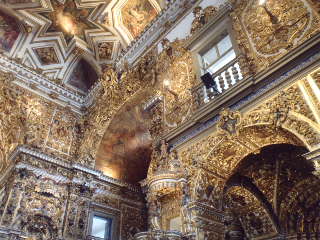
The first thing one notices is the number of churches that reside in the historic Pelourinho district of Salvador.  There seems to be a church on every corner. They say there are over 165 at last count! We had the opportunity to go into the Church and Convent of Saint Francis.  We see beautiful blue tile mosaics lining the cloister.  The tiles came from Portugal between 1743 and 1746.  This is the largest collection of blue tiles outside of Portugal. 


The Church of St. Francis is one of the best models of the first age of the Baroque style, or as it is usually called “the colonial style”.  The carvings are completely covered with gold leaf and gives the impression of a Golden Church.  Stepping into the church was jaw dropping!


Outside of St. Francis Church

The city of Salvador is divided into two levels.  There is the Lacerda Elevator, which takes one from the lower to upper level on top of a hill.  It costs R$.50 in Brazilian money (Reals), which is about US$.30 for a ride.  The views from the top overlooking the ocean are wonderful.
Elevator from the lower part of city to the top of the hill

 
Walking through the Pelourinho district is a living reminder of its Portuguese colonial past.  The cobbled streets are lined with colorful churches, museums, boutiques, and houses.  This is the area of town that holds the Carnaval celebrations and parades.  The Salvador Carnaval is by far the biggest street party in the world.  Every year around 2 million people participate in the parades.  During six consecutive days, from 5 pm to 5 am, dozens of bands make a parade along the streets, playing on big trucks (called Trios).  We won’t see this as the ship leaves port at 5 pm. 
Welcome to Salvador Carnaval

 
Crowds, but nothing like the evening crowds.  These are all tourists.

African drums, etc. for sale

Hair all decked out for a party

Carnaval ribbons adorn the fences

Art for sale
This guy had the coolest job in town.  That's ice he's carrying on his head.
Coconut water for sale

Lots and lots of jewelry for sale

But after a day at sea, the next stop is Rio deJaniero and we will be at port overnight and plans are to get over to the Sambradome where Carnaval takes place.  We will tour Rio during the day on Sunday, hope to see a little bit of Carnaval at night, and then the next day we leave the ship and fly to Iguazu Falls for 3 nights.  We will return to the ship on February 14 when it arrives in Buenos Aires.  I won’t be taking the laptop with so this will probably be the last posting for about at least a week.

 
Today was an excellent day; we had a lot of fun exploring Salvador.  The temperature was forecasted for 84 degrees.  With almost 100% humidity and sun, that was the hottest 84 degree day we have ever experienced.  Back on the ship, we sailed away from Salvador and enjoyed cooling off in the pool.

Wednesday, February 6, 2013

Fortaleza, Brazil and the sand dunes


Fortaleza, with a population of over 2.5 million, is the 5th largest city in Brazil. It is home to spectacular white sand beaches, warm waters and tropical climate with 350 days of sunshine a year along with some rain from January to June with high relative humidity. Fortaleza is a popular coastal resort city in Brazil, perfect for beach holidays almost throughout the year. Famous for its beaches, lively nightlife, carnivals and forró music, Fortaleza offers affordable shopping, historical sites, vibrant local culture and recreation. The port is more than two miles from the city center.

A Dutchman is credited with founding Fortaleza in the 17th century when he built a fortress in 1654.  Ultimately the fortress was seized by the Portuguese, an act that signified the beginning of the colonization of the area by the Portuguese.

Places of interest include the Centro Market, with over 600 stores, a beautiful neo-Gothic cathedral with superb stained glass windows, and the Jose De Alencar Theatre, a masterpiece of Art Noveau design.
 
Well, we didn’t really see any of those but we did see Cumbuco Beach, one of the many beautiful beaches lining the northeastern coast of Brazil. 

This was another ship’s tour.  We were bussed about an hour out of town to the beach.  Downtown Fortaleza is filled with high-rise buildings and seems quite nice. 
 
 
As soon as we left the downtown area, however, the scenery changed to very run-down buildings.  There wasn’t a wall along our route that was not covered in graffiti.  The Brazilians would really benefit from a clean up day…..trash of paper, glass, and plastic littered the roadside the entire way to the beach.


But the beach was beautiful.  The waves were quite high so we didn’t venture into the water except for our feet as we walked along the shoreline.  The water was very warm, about 84 degrees, but then we are not far from the equator.


Our tour included a dune buggy ride around the sand dunes.  This was a lot of fun!  After a few minutes’ ride, we stopped at a lookout where we could ‘slide’ down the sand dune on a sled—like a snowboard.  Terry gave it a try and flew down the dune.  Then he got to walk all the way back up!  LOL


Back on the dune buggy, our driver gave us quite a ride up and down some pretty steep hills.  Why we didn’t tip over still amazes me.  It was really a lot of fun.
Enjoying our dune buggy experience


We left our footprints in the sand and thought our first day in Brazil was a pretty good one!


Tomorrow is another sea day and then on Friday we port in Salvador, Brazil, known for attracting millions to the city for the Carnival celebrations.
Sailing away from Fortaleza

Tuesday, February 5, 2013

4 Days at Sea and we Cross the Equator


What's there to do on the ship during sea days?  Lots!!  Every evening there is a brochure delivered to the stateroom that outlines all the activities hour by hour throughout the next day.  Just pick and choose what sounds good to you.  There are seminars to attend on various subjects, games to play such as Trivia, Bingo, Bridge, dance classes, fitness classes, ice carving demonstrations, fruit carving demonstrations.  There's afternoon tea time, complete with scones and cream...yum...wine tasting parties, art auctions, ping pong and shuffleboard tournaments....and of course the pools where one can just laze the day away reading and snoozing a little.  In the evening there is always entertainment in the theatre and at least one of the lounges.  Guest entertainers come on board for about a week and do at least a couple shows.  There are string quartets and pianists playing for our listening pleasure.  And if you can't think of anything to do, there's always something to eat!  Yes, it's a hard life here on the ship!  LOL

We try to get our exercise in after breakfast by running on the deck that goes all the way around the ship.  Three times around equals one mile.  It’s sometimes a challenge to maneuver around the many people also trying to get in some exercise by walking, but we do okay.  It’s extremely windy at the bow of the ship and very humid outside, so it doesn’t take long to feel we actually got some exercise.

So, then it’s time to eat again (lunch) and then we usually settle down on loungers and read/get sleepy/people watch.  The ship personnel always have some sort of maintenance going on that is interesting to watch.  One day 2 crew members, one male, one female, were cleaning light bulbs on the aft deck.  The female held the squirt bottle and some official papers and the male held a long stick with a rag wrapped around the end.  The female would pass the squirt bottle to the male to wet the light bulb and then he would “mop” it.  One time the female grabbed the squirt bottle and mop stick from the male and redid what he just worked on.  Satisfied that it was now done correctly, they referred to their official papers to find the next light bulb and moved on.  Another crew member was busy cleaning the white plastic frames of the lounge chairs with a brush that was just slightly larger than a toothbrush.  There are hundreds of lounge chairs.  I’m sure he had an exciting day.

This morning at around 4 am the ship officially crossed the equator.  There was a ceremony held on the ship (later in the morning) to mark this occasion.  A naval tradition I think.  King Neptune and his Queen hold “court” to pollywogs (people who have never crossed the equator).
King Neptune & His Queen
 
Five people volunteered for this ceremony and hundreds gathered around the pool in the aft of the ship to watch.  They had to kiss a fish and then were lathered with raw eggs, whipped cream, chocolate sauce, and spaghetti noodles. 
Kissing a fish
Getting messy
 
If they survive all this, they now become “shellbacks”. 
Officially they are now "Shellbacks"
 
We will each receive a certificate officially stating we have crossed the equator.  It’s a silly, but fun, activity on ship.  Guess we will do it again when we cross the equator on the other side of South America.
We have attended a couple of port lectures that tell us what to expect and see in the Brazilian ports.  It’s Carnival time and we will be amongst millions of people as we venture out from the ship.  We will always be with a group of people (and a guide) and we are so ready to step foot in Brazil!  Tomorrow....Fortaleza, Brazil.

Friday, February 1, 2013

Trinidad


Today’s port was Trinidad, located just off the coast of Venezuela.  Trinidad is not your typical Caribbean port.  Cruise ships dock right next to Port of Spain’s downtown, which has an urban feel, with skyscrapers, a financial center, arcade malls and lots of traffic.
 

The city is a regional financial and business center and has one of the fastest-growing economies in the Caribbean.  Oil and natural gas production, not tourism, is the island’s biggest industry. 

Trinidad was “discovered” by Columbus in 1498 and controlled by the Spanish until the British navy showed up in 1797 and took control.  Although the nation gained independence in 1962, remnants of British rule include the use of English as the national language and left-hand driving.

Other than that, Trinidad’s culture is mostly influenced by the Indians (India), Africans and Chinese brought over in the 19th century to be indentured workers in the sugar industry.  The multi-cultural society is quite harmonious and we saw signs while driving through town that read:  “For each creed and race, we are all in an equal place”.

There were dancers on stilts entertaining the cruise passengers at the port terminal as we left the ship.  I think this is similar to what we will see in Brazil for Carnaval.

Knowing that venturing away from the city can put the tourist in a not so safe way on this island, we booked a tour through the ship.  It was a hike to Maracas Waterfall.  Our tickets said there will be slippery rocks and you MUST be in excellent physical condition.  Hiking and waterfalls sounded like a great tour to us, so off we went.

On our way up into the rainforest we drove through the outskirts of the city.  It seemed like each house had a tall cement wall surrounding it and then topped with coiled barbed wire. Again, some houses were neat and tidy; others looked awful.  There was trash littering the sides of the road all the way across the island. 

We passed elementary school children running a race UP the mountain.  They were working hard and their classmates were alongside the road cheering them on.  We opened the bus windows and encouraged them on.

When we were almost to our hiking destination, our bus pulled over and stopped at a police station.  We waited there for our police escorts to show up.  That was a little unnerving!  I guess a group of people, especially tourists, walking around in the wilderness would be a good target for robbers.  Our policemen stayed with us the entire time; they carried machine guns!

When it was time to start our hike, our guide briefed us on the following:  The hike is uphill, wet, covered with fallen leaves, and the rocks are very slippery—don’t step on them, try to step on the loose gravel around the rocks.  Oh, and we do have snakes and they are poisonous so don’t touch.  Oh, and by the way, there is poison ivy along the trail.  With that, our group of about 30 headed up the hill.  It definitely was slippery and we had to watch every step we took.  One man went rogue and didn’t follow the path led by our guide.  Down he went into the rocks.  He was a big guy and it took 2 guides to stand him up. 

We finally reached the waterfall and looked up!  It was 300 feet tall and more of a misty water falling down than a rush of water.  It was very nice and cooling.  We like to take a photo standing under the waterfall, so Terry volunteered to head across the rocks and take position, arms outstretched, while I snapped a few pictures. 
 

Right after I took the pictures, the guy that had fallen on the way up to the falls walked by me and slipped.  He knocked me down like a domino right into the rocks—I didn’t have a chance against a big guy of at least 250 lbs.  So my souvenier from Trinidad is going to be a nice big black & blue bruise on my leg.  I’m thrilled!  But a bruise is better than a broken leg so I’m thankful that’s all it seems to be.

I had hoped that once we got back to the ship we could walk over to Queen’s Park Savannah and the Magnificent Seven, which is a group of 7 old sea captain houses.  But walking is a little uncomfortable for me right now so we passed.  I’d say we’ll save that for next time, but I doubt this is a port we will visit again.  Only ships sailing to South America would stop here.
The next 4 days are sea days before we reach Fortaleza, Brazil.  According to the Captain’s Log, we have travelled just over 1600 miles from Fort Lauderdale and have 14,500+ miles before we reach San Francisco.