Friday, February 14, 2020

Ushuaia--we board the ship and cross the Drake Passage!

We have an early morning flight to Ushuaia, known as the "City at the End of the World".
Before checking into our hotel, we take a little ride around the town.  Ushuaia is a busy port with a frontier atmosphere.

The snowcapped Andes rise on one side of town, while the magnificent Beagle Channel extends from the other.
 It's a bit of a drop in temperature from the warm, humid temps of Buenos Aires.  There is wind coming off the snow-capped mountains so jackets are necessary.

We stopped by the Malvinas Memorial Park.

The memorial commemorates the 649 Argentine servicemen who were killed in the war for the Islas Malvinas (or as the British call it, the Falkland Islands) in 1982.

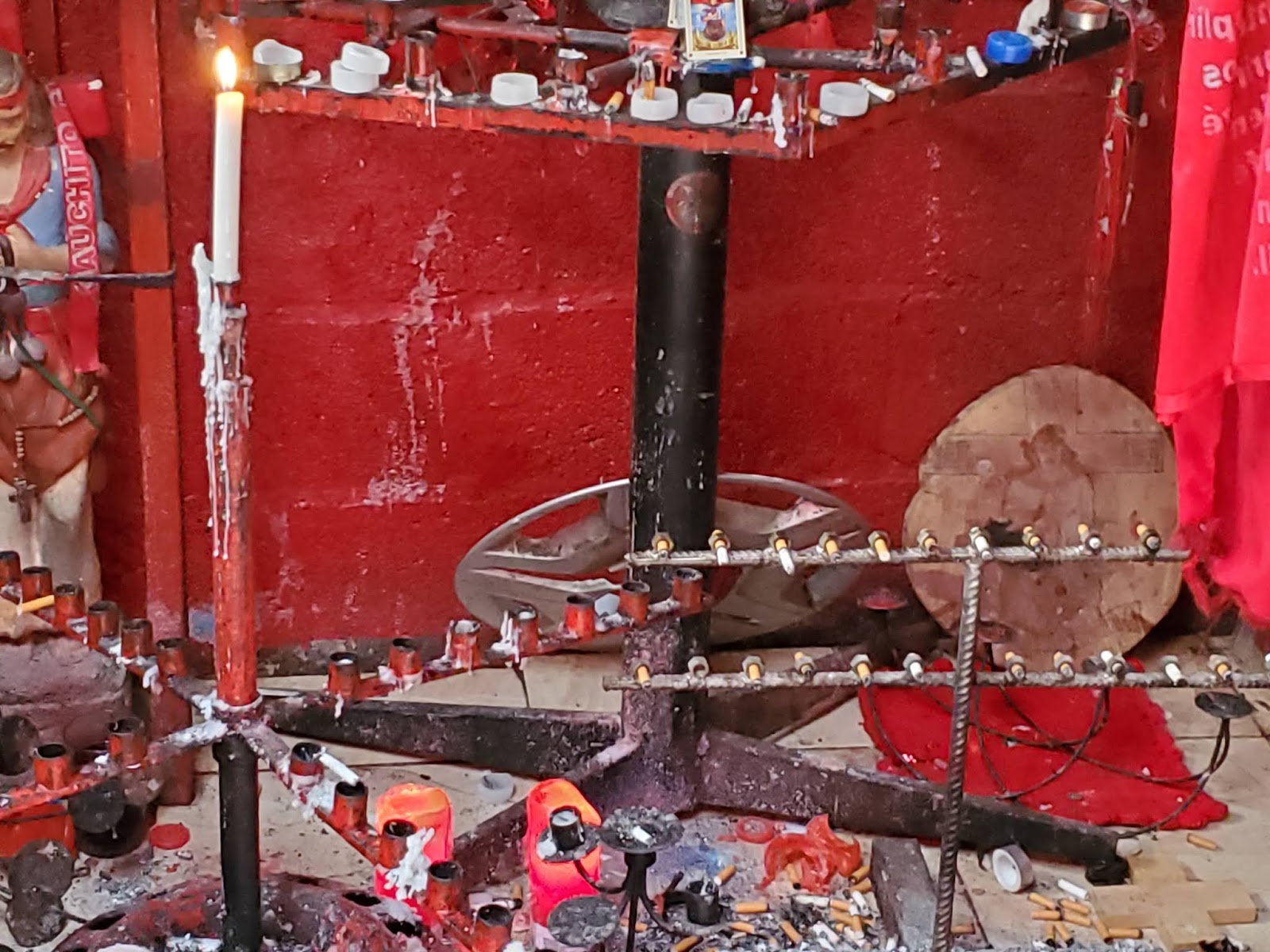
Next we drove out of the city a short distance to the Gauchito shrine.

Although Gaucho Gil is not an official saint in the church, he is revered throughout the country of Argentina and is a "defacto saint".  Gaucho was a deserter of the military who evaded capture for quite some time. During that time, he was a sort of "Robin Hood" figure, robbing from the rich and giving to the poor.

As is the custom in Argentina, our Trip Leader, Marta, left an offering for the saint for safe travel for our group.
 Gaucho Gil liked beer, but Marta couldn't find any to buy so we left some grain instead.  Hopefully that works!!
Then we entered the shrine.
Quite interesting.
Now, Argentineans have built shrines throughout the country to honor the memory of Gaucho Gil.

After stopping by our hotel, we wandered down to the main street in the town and stopped to have a late lunch at "Freddys".  It definitely is the best place in town for fresh seafood, including lots of crab.

We walk around the town a bit and down to the harbor area.  The ship that we will be traveling on is due in the port later this evening.  No sign of it yet.
 The lupine and poppies are in full bloom...it is the beginning of summer here south of the equator.


The next morning we are up and checked out of the hotel by 8 am.  Our ship has arrived and will say goodbye to the current passengers this morning, and then the crew spends several hours preparing the ship for the next voyage--the one we will be on.

We won't be on that big one in the background of this photo.  That's a Celebrity ship, which will also be heading to the Antarctic, but they are only allowed to do a "drive-by"....no landings on the continent.  The smaller ship in the foreground is the M/V Corinthian, a 98-passenger expedition ship.  That's the one we will be on and we will be able to actually step onto the Antarctic continent.  More about that later.


Since we won't be able to board the ship until later this afternoon, our group takes a ride into the Tierra del Fuego National Park, Argentina's only coastal national park.

Our destination is this lake.
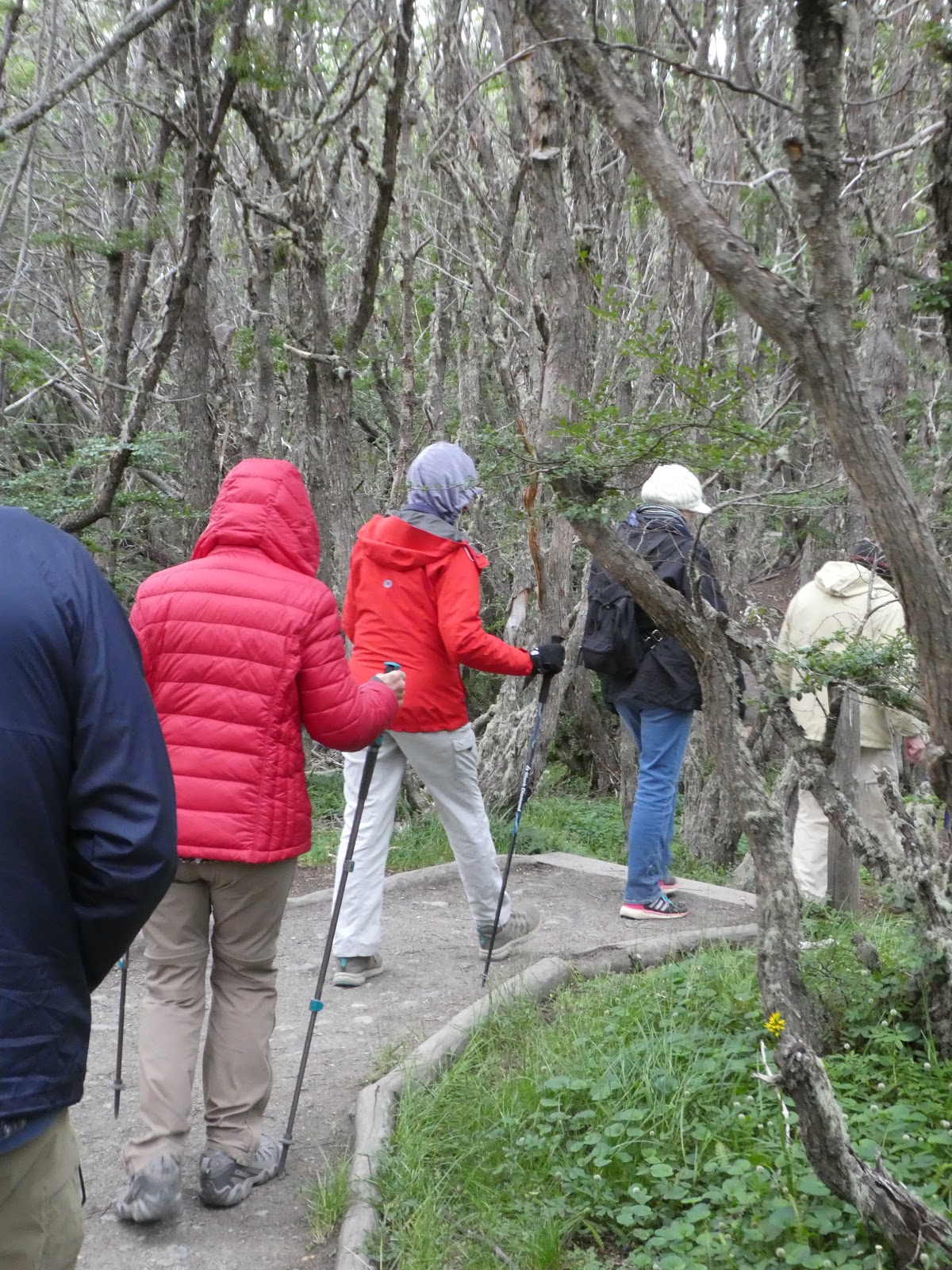
 We set out to hike along the shoreline and through the forest.
 Along the way we see swans...
 and the trees of this sub-antarctic forest.
 Beautiful landscapes
 and more birds.  This one was protecting her babies.
Our local guide tells us about the Lenga trees, a species of tall deciduous southern beech trees.

 Our final stop is at the very end of the Pan-American Highway, which runs from North America, through Central America and ends here at the bottom of South America--a length of about 19,000 miles.
 And beyond the sign there is a short trail which leads to this overlook.
A great way to spend the morning, but we are really anxious to board the ship and make our way to Antarctica.


Back in Ushuaia
Our ship is ready for us...it's the center one of the front three. 
 Before we board, our Trip Leader, Marta, orchestrates our group photo.  We are excited and ready!!

And now the voyage begins on the M/V Corinthian
photo from internet

 Here's a look around our cabin.  We chose one that was low and center on the ship in hopes of minimizing the bouncing of the waves on the sea.  There are actually "seat belts" under the mattress to keep from falling out of bed in case the seas are really rough.


Then it was time to meet the crew.  This is our Expedition Team.  Each naturalist has a specialty--like, birds, geology, mammals, history, etc.  Throughout the cruise they will do presentations about Antarctica and will accompany us on shore.
 These are the ship's captain and officers. including a doctor.
 The chefs and kitchen crew...

Our dining room servers

 The housekeeping crew...there's a total of 65 crew members.  We are among 88 passengers; that's a pretty good ratio.  I think we will be well taken care of.
 And the hotel manager.  He's looking at his watch.  I think it was time for dinner as we sail away.


We left port around 7 pm.  We first sail through the Beagle Channel, named after the ship Charles Darwin traveled through in 1831.  The Beagle Channel is about 150 miles long and 3 to 8 miles in width.  It is basically calm, which gives us a nice start to the journey.
Here's the map of the route we will take on the expedition.  It will take 2 days of sailing across the Drake Passage to reach the Antarctic Peninsula.


Now a little bit about the Drake Passage.  Knowing we have to cross this body of water is probably the one thing that causes secret anxiety and apprehension about this trip. Why?  


Because the passage is a narrow area between South America and Antarctica where three oceans meet, or I should say, collide:  the Atlantic and the Pacific meet the cold waters of the Antarctic (or Southern) Ocean.  This can cause strong winds and violent seas.  At 500 miles, it's the shortest distance from any continent to Antarctica.  It will take 2 full days of sailing to cross.  

It seems that this will be a rite of passage as we seek our chance to connect with the 7th continent.

It's said there are two kinds of seas on the passage:  the Drake Shake and the Drake Lake. 

It was midnight before the ship left the Beagle Channel and entered the Drake Passage.  We were sound asleep but I remember waking around 2 am to the ship rolling a bit on the seas.  Not bad, it actually lolls one back to sleep, like being in a swinging hammock.  

When I woke up the next morning and stepped out of bed, that was when I found myself losing my balance and being tossed against the wall as the ship rolled.  It was time to get our "sea legs".

In preparation for possible seasickness, we had prescription Scopolamine patches that we put behind our ears when we boarded the ship.  Never used them before but I can say they worked great.

internet photo

 No feeling of nausea at all; we only had to be careful walking as everyone looked like "drunken sailors"  as we navigated our way around the decks of the ship on the rolling seas.

By midafternoon we were definitely in calmer waters.  We had experienced a bit of a mild "Drake Shake" and were heading into the smoother waters of the "Drake Lake".  We were very lucky!

Our days at sea were spent getting to know our expedition leaders as they presented educational seminars about various topics including wildlife, history, geology, glaciology and climate change, to name a few, during the entire crossing.

This one pictured is the "bird man". Ken, during his presentation "An Introduction to the Seabirds of the Southern Ocean".


Following his presentation,  we went outside on the deck for bird-watching.


And as if on queue from Ken's lecture, a colossal immature Wandering Albatross flew in and made a couple of very close passes before venturing off.  That was a great wildlife experience!

Here's Ken's photo

We celebrated New Year's on the ship after that first day on the passage.

Our trip leaders


The second day we continued to experience the Drake Lake.  Thanks to this good weather during our transit of the Drake Passage we learned that we had time to divert course for a surprise activity:  a landing in the Aitcho Islands, a series of small islands and rocks in the South Shetlands archipelago.


We were briefed on the procedure we would follow.

First we had the mandatory IAATO briefing on the code of conduct we follow during our visit to Antarctica, as well as instructions on how to board and use the zodiacs--the rubber inflatable boats used for landings,
And we were fitted with the rubber boots we would wear during the landings.


We also went through biosecurity inspections and gear cleaning, a precaution necessary to avoid the contamination of the Antarctic environment with species alien to the continent.

And soon we are ready to board the zodiac and go ashore.  You will notice we all have the same red jackets on.  They were given to us by the company to wear on the expedition.  They are windproof and waterproof and will be nice and warm.  

In addition it was necessary to bring waterproof pants, like ski pants, to wear and also waterproof gloves.

 The temperature was about 37 degrees F.
Waterproof clothing is necessary as the ride in the zodiac can mean getting splashed on and also most of the landings are wet landings, meaning we step into water when exiting the zodiac as we had to in the photo below.  The rubber boots we wear come to just below the knee.
There are many other expedition ships doing a similar tour in the Antarctic.  The ships coordinate the landings with one another because only 100 people are allowed on land at one time in any area. This is the reason the big cruise ships like the one we saw in Ushuaia with 3000+ people on board cannot do landings, just "drive-bys".  Also, the big ships would not be able to enter some of the shallow bays.

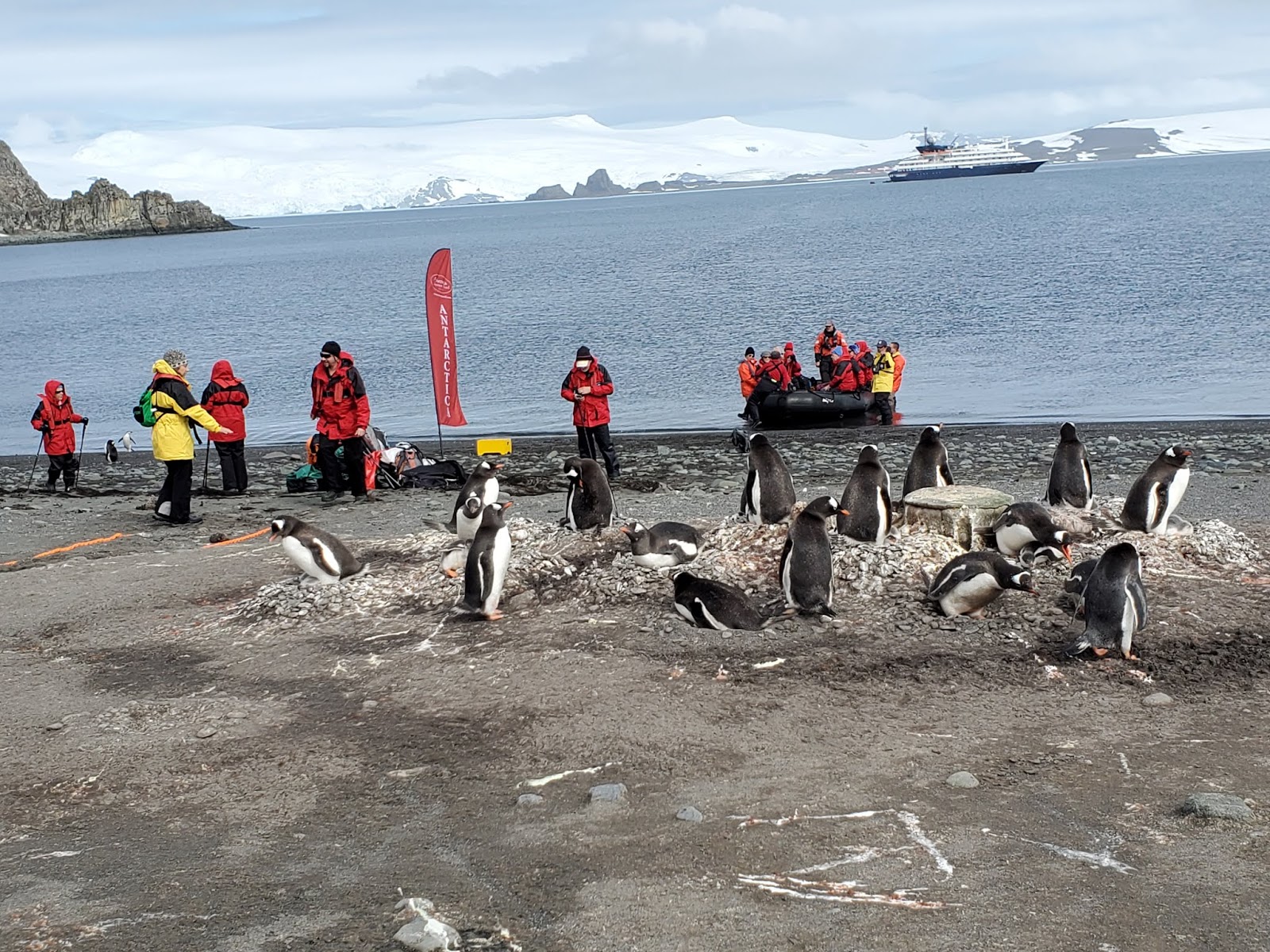
We have a welcoming committee of Gentoo penguins!  We are free to walk among them in this penguin rookery.  We are asked to keep a minimum of 15 feet away from the penguins, but if they approach us and are closer, that's okay.


You will notice there is an orange plastic chainlink rope on the ground.  The expedition team laid that down  as a reminder to us to keep a little distance between us and the wildlife.


We had fun watching this penguin.  He didn't quite know what to think of the orange chain.
 He didn't want to cross it so he walked around it.


Many of the Gentoo penguins are on nests.  Most of the eggs have hatched and the chicks are growing.

We also saw Chinstrap penguins here...it doesn't have the black on the chin like the Gentoos.  Instead there is a black line that looks like a strap on the chin.

We wandered around the area watching the penguins and the Scuas birds flying overhead.  They were looking for an opportunity to snatch away an unguarded chick.

The island was surprisingly colorful--it's not just dirt and rock.  The green is a thin layer of algae and the yellow and oranges are mosses and lichen.

There were three Elephant Seals on the beach among the penguins.  They stay on the beach for about 3 weeks during their molting season before returning to the sea.

 Looks like they sleep a lot through the molting process!

We enjoyed watching penguins wandering to and from the sea to forage, "flying" through the water at the beach, feeding their chicks back on land, trying to steal pebbles from other nests


and defending their nests from the pebble thieves and their chicks from the Skuas birds. Here's another Chinstrap penguin.

Too soon, it seemed, we returned to the landing site


 and boarded the zodiacs for the quick trip back to the ship.
It was time to sail on towards the Gerlache Strait as we get closer to the Antarctic Peninsula.  This was a most exciting day.  We will have 4 more days in Antarctica...can it get any better than this?

To continue reading, scroll down and click on "Newer Post".

ANTARCTICA! The White Wilderness


"Antarctica??  Why do you want to go there?"  We heard this phrase ALOT when we started telling friends and family where we were headed on our next adventure.

It was a destination that we had not even thought about until we started seeing photos and hearing stories from fellow travelers who always ranked this trip to be one of their all-time favorites.  We got interested and started thinking...and then ran across this quote from Eleanor Roosevelt:

"The purpose of life is to live it, to taste experience to the utmost, to reach out 
eagerly and without fear for newer and richer experience."

So, what else could we do?  We had to discover for ourselves the pristine beauty of this great white wilderness and 7th continent of the world, even if it meant crossing the Drake Passage, which can have the most violent seas in the world.

Our adventure begins on the day after Christmas, 2019, when we headed to South America to meet our tour group with Overseas Adventure Travel.

 Our first destination is Buenos Aires, Argentina.

It's an overnight flight; we arrive about 7:30 am.
After going through Passport Control at the airport we are met by an OAT representative and a driver who whisks us off to our hotel, the Panamericano, located just a block from this obelisk, the most iconic monument of Buenos Aires.
 It's only late morning, but we are able to check in to our hotel room and relax a bit after a day and night of air travel.

Late in the afternoon we meet our Trip Experience Leader, Marta, and our fellow travelers.  Our group includes 22 people.  Marta gives us an informative briefing about our trip...
 ...and we toast to a wonderful adventure with the welcome drink of Argentina.
 Then it was on to a local restaurant for our Welcome Dinner at a traditional Argentine steakhouse.  Argentina is known for great beef and we were not disappointed!

After dinner Marta led us on a walk along the Rio de la Plata River and across this bridge, named the Women's Bridge.

It's design symbolizes the dance of Tango, the most popular Argentine dance, where the strong man supports the woman who leans back in his arms.

The next morning we join our group on a City Tour.  We have been to Buenos Aires twice before and have seen many of the sites but seeing them again is no problem for us, plus it gives us a chance to get to know our fellow travelers. Here's a few photos of what we visited:

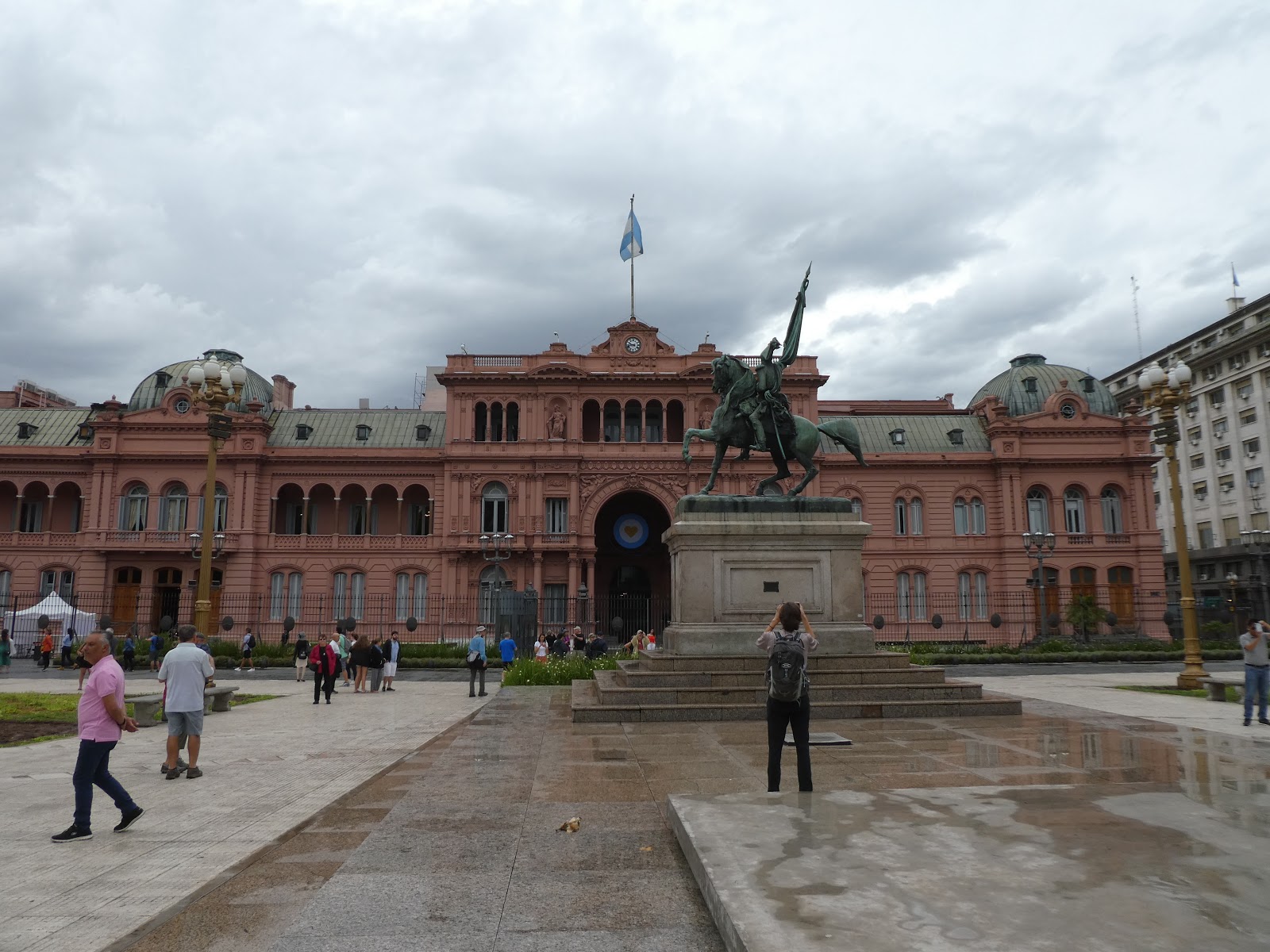
First we head to Plaza de Mayo to see the famous "pink palace", Casa Rosada, the official Presidential Office in Buenos Aires, and where Juan and Evita (Eva Peron) addressed the masses from the balconies in the late 1940s and where Evita sang "Don't Cry for Me Argentina"  in the movie Evita.

Then we walked across the plaza to the Metropolitan Cathedral

 where Pope Francis used to perform mass as Archbishop Jorge Bergoglio before assuming his duties in the Vatican in 2013.

This monument in the plaza honors Argentina's Independence Day, May 25, 1810.

We saw many mosaic white scarves in the pathway around the monument.  Our local guide and Marta explain the significance of the white scarves, which represent the Grandmothers of Plaza de Mayo.


The Grandmothers of the Plaza de Mayo is a human rights organization of Argentine grandparents whose children "disappeared" during the military dictatorship, between 1976 and 1983. They organized while trying to learn what had happened to their children and grandchildren kidnapped during the repression, and began to march in 1977 at the Plaza de Mayo.


The adult children had been killed; the babies and children were illegally adopted by families of the right-wing followers.  The scarves commemorate those that disappeared and the grandmothers who are still in search of their grandchildren.

Back on the bus, we drive to the neighborhood of La Boca, Buenos Aires' first merchant and fishing port.  Between 1880 and 1930 about 6 million people immigrated to Argentina.  About 50 percent were from Italy, many from the port town of Genoa.
We stopped and strolled through the Caminita streets where we saw tango dancers and artists and colorful buildings.  The houses here represent the neighborhood's typical tenement shacks, covered in corrugated metal and originally brushed with leftover paint that Genoese port workers got from the ships.

Numerous mannequins hang from balconies of the brightly colored buildings looking down at the street.  Several portray famous Argentinean personalities.

Caminito (or "little path") was named after a 1926 tango song, which tells of a love lost. This song inspired Benito Quinquela Martín, La Boca's most famous artist, to help create Caminito in 1955.

And then we met the tango dancers.  We recognized the woman.  She was the same one who gave us a tango lesson on our last visit to Buenos Aires in 2018.  I hope she doesn't ask if we have been practicing!

They performed a couple of dances for us.


And sure enough, it was then time for our group to have a tango dance lesson.

Oh, yeah, we can do that!

We all tried, and with the addition of a red scarf for the women and a fancy hat for the men, we felt like we had mastered the tango....NOT!  But we gave it a good try and had fun.

The last stop on our city tour was to the Recoleta Cemetery.  It is considered one of the most unusual cemeteries in the world and a must-see stop for any visitor to Buenos Aires.

Most of the graves are built above ground and include elaborate carvings and marble pillars.  This photo is from the internet to show an aerial view of the cemetery.

The grave all visitors want to see is for Eva Peron (Evita), Argentina’s iconic first lady, idolized by the public until her death from cancer in 1952.


 It is very plain considering the elaborate graves nearby.

The most interesting thing about her grave has to do with how long the government hid her body before finally interring it in the Recoleta Cemetery – it only took 20 years.  “Evita lies five metres underground, in a crypt fortified like a nuclear bunker, so that no one should ever again be able to disturb the remains of Argentina’s most controversial First Lady.”

We then wandered through the maze of tombs

 and stopped for a couple of interesting stories:

This one is for Liliana, who was honeymooning in the Alps when she and her new husband were killed in an avalanche.  Her grave is said to have been modeled on her childhood room and is made entirely out of wood and glass, not a stone used, presumably in silent protest of the killer avalanche.


And then there's this one that will give you a chill:  Rufine was buried in 1910 at 19 years old believed to have died while in a coma.

But grave-workers heard her screaming from the grave. When they dug her up, they reportedly saw evidence that she had unsuccessfully tried to claw her way out.  A claustrophobic person’s worst nightmare!

By now it was time for lunch and our Trip Leader suggested we all go to her favorite pizza restaurant near our hotel.

 Argentina is not only known for its beef, but also for pizza and pasta due to the large population of descendants of Italian immigrants.  You can see the pizza is very, very cheesy.  There's actually a sampling of another pizza on top of this one for us to try.  It was all very good.

Terry ordered a "large" beer.  What came was an entire pitcher, which he thankfully shared with our tablemates...we still had more to see this afternoon.

That afternoon we had reserved tickets for the Opera House tour with our "traveling buddies", Margaret and Ken.  They live in our same town and we traveled to Egypt and Morocco with them last year.

This is the Teatro Colon, or the Opera House, considered to be one of the best theaters in the world.  The theater originally opened in 1857 and was restored to this white-marble glory in the early 2000s.  This is the foyer, or entrance hall...quite grand!
 This is looking up while standing in front of the huge staircase.  The stained glass is French.

Here's the Golden Hall, a permanent center for chamber music concerts.  The ornate architecture is a mix of Italian and French.
In this hallway there are carvings of famous musicians, like Mozart, adorning the doorways.

And finally, what they call the "Room".  It is famous throughout the world for its acoustics and decorative richness. Luciano Pavarotti once said he dreaded performing in this majestic theater--the acoustics are so perfect, he said, that he could hear his every mistake!  The stage is set for the evening performance of Swan Lake.

Well, that about takes care of a quick visit to Buenos Aires.  One more thing we thought was interesting was some signage:

This one indicates that there is a school nearby so watch out for children.
This one was most disturbing.  It warns of human trafficking.  Do not smuggle people in suitcases.

The next day we leave Buenos Aires and fly to Ushuaia.  The city at the "end of the world" and our jumping off point to head to Antarctica, where we board an expedition ship to cross the Drake Passage.

To continue reading, scroll down and click on "Newer Post".