Tuesday, November 8, 2011

Back in Spain

Located just above the boundaries of northern Portugal, Vigo is a Spanish city originally settled by Celts in 600 BC, giving it a longstanding Celtic tradition that lives on today through legends and the music of bagpipes. Not what we would think of for Spain; in fact, our tour guide today was a local with blonde hair and blue eyes!


Vigo is an important fishing and commercial port. As we left on our tour for the day, we drove along the coast and saw mussel flats, each one owned by a local family. Ropes are hung from the flat to the bottom of the harbor where mussels attach themselves and grow to be harvested.

Mussel flats in harbor
Our choices for touring today were: Santiago de Compostela, with its cathedral which is considered the 3rd holiest place in Christianity behind Jerusalem and Rome. The Apostle St. James is said to be buried there and pilgrams from all of Christiandom flocked to the magnificent cathedral built between the 12th and 13th centuries. It also was featured in the book by Ken Follett, “Pillars of the Earth”.

But we didn’t go there. Instead we took a winery tour and wine-tasting since Vigo is in the heart of Galicia’s (this area of Spain) Albarino wine country for a little variety in our siteseeing and a chance to have a laid-back day. It was a fun day and there was no holding back on the wine—one could have as much as one wanted, along with an assortment of tapas to munch on, and the busload of cruisers seemed pretty happy. We enjoyed the company of another couple from our cruise critic rollcall group. We will be on the same small group tour with them when we are in the Azores a few days from now. It was nice to have a chance to get to know them. They did a 12-day tour in Egypt before coming on this cruise and had a wonderful time. We always enjoy hearing the experiences of travel in parts of the world we hope to travel to someday.
The Agro de Bazan Winery
The winery's vineyard

Typical courtyard

Architectural style of balconies
Wine, tapas, and good conversation
Next up is Lisbon, Portugal

Monday, November 7, 2011

Normandy and the D-Day Beaches

Our choice for the port of LeHavre, France was to either go to Paris or to the beaches and memorials of D-Day in Normandy. Being our first time here, we wanted to go to Normandy and pay tribute to those who fought so bravely in WWII.


The weather was as predicted today…..raining in LeHavre when we left on our tour. We left the rain but experienced cool weather and very strong winds coming off the Atlantic Ocean on the beaches of the landings where the Allied liberators started their massive invasion on June 6, 1944. So out came the gloves and headbands in this very typical Normandy weather which we learned is very much like that day in June, 1944.

Our first stop was at Omaha Beach, the site of the most difficult and bloody invasion. As we stood on the beach, we could visualize what happened through our memory of scenes from the movies, “The Longest Day” and “Saving Private Ryan”. We had an excellent guide, through Overlook Tours, who showed us photos taken in 1944 and recounted events at various sites as we stood at the same spot today. He told us how the hedgerows outlining the farms and roads in the area became an unforeseen problem as soldiers could not make their way through the tangled brush and could not tell if there was friend or foe on just the other side of the hedgerow.
Bunker on hillside at Omaha Beach

Omaha Beach
Overlooking Omaha Beach
Photo of church in 1944
Same church now rebuilt
Hedgerow
Next we visited Pointe du Hoc where American Rangers courageously scaled sheer cliffs on rope ladders while under constant fire to attack the German defense. Terry and our guide went down into one of the many holes around the Pointe to show how deep the explosions of artillery blasted out the area.
The cliffs the Rangers had to climb from the beach

Deep hole blasted out by artilliary
We had lunch overlooking the church in Saint Mere Eglise, where paratroopers dropped from the sky early in the morning ahead of the beach invasions. This church was where a paratrooper landed on the roof of the church, his parachute caught on the steeple. The fall knocked him out and when he awoke, he played dead until he could get himself untangled and off the roof. He was captured but escaped the Germans 2 days later. Our guide said that this paratrooper lived to be 96 years old. There is a parachute on the steeple to help the tourists visualize the event. We remember that this was also a scene in the movie, “The Longest Day”.
Church the paratrooper landed on.  Parachute on steeple marks the spot
Our final stop was at a 12th century church at Angoville au Plain, where two American paratrooper medics administered life saving aid to a mix of some 80 American and German soldiers wounded during the first day of the Normandy invasion. This village was overrun by troops of both sides several times during D-Day.
Memorial to paratroopers
Church used as a hospital for both American and German soldiers
This was definitely a day of reflection and gratitude to those who fought and gave their lives for freedom and we will never forget.
American cemetary with over 10,000 graves
Memorial pool at American cemetary

Sunday, November 6, 2011

If it's Saturday this must be Belgium!

Today we are in Belgium. It’s nestled between Germany, France, and Britain, and is famous for lace, waffles, chocolate, friets (French fries but they are Belgium) and even beer.

Through connections with the cruise critic rollcall for this voyage, we were a group of 8 who had pre-arranged a taxi to take us from the ship’s port in Zeebrugge to the quaint city of Bruge, about a 30-minute drive away. Well, we had a snafu and our taxi did not show. This was a chance we took as we had read that often people will hijack another group’s taxi by saying they are the party on the sign the taxi driver has. After waiting about 30 minutes, we figured we were either forgotten or hijacked. We were very lucky to have friends in our cruise critic group and one of them had arranged for a coach bus to transport a number of people. There was room on the bus for our group, so we joined them for the ride to/from Bruge. Whew!!

Initially a trading center in the 11th century through the 16th century, today Bruge prospers because of tourism. It’s a uniquely well-preserved Gothic city and the tourists have found it!

Store window filled with lace products
....and chocolates everywhere!

With a Rick Steves’ book in hand, we followed his suggested walking tour of the city through the squares and along the canals and over the pedestrian bridges. Our first stop was the bell tower that has stood over Market Square since 1300. We climbed about 360 steps up the circular tower for fantastic views of the city. Just before we reached the top, we could see the carillon room, where the 47 bells are played on the quarter hour. We saw the carillonneur using his fists and feet to play the bells.
Bell tower
Very steep, narrow, winding steps to the top of the tower
The Carillonneur
View from top of bell tower of Bruge
We wove our way through narrow streets and large squares, crossing the canals from time to time and enjoying the beauty of the area. The weather was ideal….we were really expecting rain as there is a 50/50 chance at this time of the year.
Canal in Bruge
This portion of canal was originally the moat around the city

Our Colorado neighbors joined us today and we all met at the De Halve Maan Brewery where Terry and Bob went on a tour of the brewery while Tissy and I visited in the restaurant. Unfortunately the brewery tour turned out to be more of a museum and not a working brewery. Hasn’t been for many, many years. But the guys enjoyed their free glass of beer after the tour and chatted with some locals about the Greek situation and the Dave Matthew Band (Terry had on a DMB t-shirt which sparked the discussion).

Deep in discussion with a couple of Bruge locals
We thoroughly enjoyed our day in Bruge. What a fantastic and picturesque city—a definite must-see for anyone going to Belgium. There is so much more to see and museums to visit, but that will have to be another time.

Next…..France and we’ll go to Normandy D-Day beaches and memorials.

Friday, November 4, 2011

Day 14 - Back in Southampton...for just a bit

After leaving Gibraltar we spent 2 days at sea before arriving in Southampton, Great Britain, where all of the Brits we met during the past two weeks leave this ship and we’ll welcome today new cruisers, mostly Americans, to take the trans-atlantic voyage for the next 15 days.


We left the ship this morning, boarded a coach bus, and headed to the Stonehenge area, about 30 miles away. It’s a rainy day and we are in and out of showers as we travel through the English countryside, through the “New Forest” (planted by William the Conqueror about 900 years ago so that the area could maintain wildlife that they would subsequently hunt). In spite of the cloudy, rainy day, the forest was beautiful with the tree leaves in full fall color. We passed through quaint English villages with thatched roofed houses. Our guide said that a thatched roof can last 50 years! It’s made of hay and covered with chicken wire to keep the birds from hauling away strands of hay to make their nests. Never got a picture of a thatched roof as we sped by too fast and raindrops covered the windows.

Stonehenge evolved from a simple bank and ditch in the Neolithic period some 5000 years ago to a very sophisticated stone circle built on the axis of the midsummer sunrise. The bluestones were brought 240 miles from the Presell mountains in Wales. There are many stories about the significance of Stonehenge. It may have been an astronomical observatory or used for sacred rituals linked to the sun, successful crops or even the dead.
Here we are in front of Stonehenge...in the rain
Artist rendition of what Stonehenge probably looked like
We headed toward the town of Salisbury by first passing “Old Sarum”, which is a huge earthwork raised in about 500 BC by Iron Age settlers, and later occupied by Romans, Saxons and Normans. They built a castle and a royal palace and by the mid-12th century, it was a busy town with a fine new cathedral. Lack of water and squabbles between church and military led to the building of a new settlement by the river, now known as Salisbury. Old Sarum was abandoned and fell into ruin. There is nothing left of any building today.
Old Sarum
In Salisbury, we visited the Salisbury Cathedral. I believe this cathedral was the inspiration (and/or filming was done here for the mini-series) of “Pillars of the Earth” by Ken Follett. It is one of Britain’s finest medieval cathedrals. Its spire is the tallest in all of Britain, and the inside is spectacular. There is nearly 800 years of history inside the cathedral including tombs of nobility from the 13th century and Europe’s oldest working clock (1386). The clock is outside on the bell tower; we got a close-up look at the working mechanisms inside the cathedral.

Salisbury Cathedral
Tallest spire in all Britain
The mechanisms of the oldest working clock in Europe
A tomb dated early 1200's


Also inside was one of the four remaining original texts of the Magna Carta. It is 76 lines of Latin exquisitely written on one page of vellum. No photos were allowed of it so I’ll need to find one on the internet for the photobook. It limited the power of the ruling monarchs and nobility back in 1215 AD and protected the rights of the citizens. Since then many countries’ laws as well as our Declaration of Independence are modeled after main points of the Magna Carta.

We headed back to the ship and will soon attend a Meet and Greet of many cruise critic rollcall members that we ‘met’ on the forum prior to the cruise that are boarding today.

Typical Salisbury street
Another street in Salisbury
Tomorrow we are in Belgium!

Wednesday, November 2, 2011

Gibraltar

Today’s port is Gibraltar…..also known as “The Rock”. It is a peninsula 2.75 miles long, ¾ of a mile wide and 1,400 feet in height. A population of about 30,000 people live in Gibraltar, which is part of the United Kingdom. With its strategic location at the western entrance of the Mediterranean, “the Rock” offers great value as a military strong point. Europe is only 8 miles from Africa at this point. Whoever controls Gibraltar and the harbor at its base is in a good position to control the passage between the Atlantic and Mediterranean waters.


The Rock--Gibraltar


Over the centuries control of Gibraltar has passed from the ancient Greeks and Romans to the Moors from North Africa to Spain and finally the British.

Our plan today was to walk into town from the port and then take the cable car up the side of the Rock. There are roads zigzagging around the top and side of the Rock and plenty of stairs to go from one level to another. We changed our plans when we started to realize how long it would take to walk on these roads to get from one site to another in the limited time we have. So, we became a party of 8 to take a taxi tour of the Rock. In 1.5 hours we were able to cover all the sites on the Rock.

At our first stop we went inside St.Michael’s Cave, with its chambers of stalactites. There is an underground cavern which has become an amphitheater for concerts, plays, and even an occasional wedding.
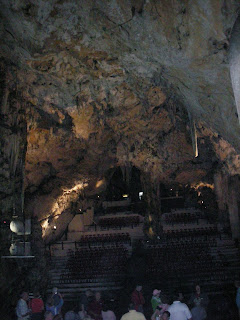


The amphitheater inside the cave
 Then it was on to see the Apes Den, home of the famous Barbary Apes. Actually tailless monkeys, the Apes are native to this area, but not to the rest of the Spanish mainland. Legend has it that Britain will retain the Rock as long as the Apes live here. At one point during WWII, they seemed to be dying out so to boost morale of the troops, Winston Churchill gave the legend a bit of help by bringing in ape reinforcements from North Africa in 1944.

At several overlooks of the area, we had a good view of the airport runway down below. It stretches from one coastline to the other, a distance of no more than ¾ mile. It separates Gibraltar from Spain and what is most unusual about it is that the road from Gibraltar to Spain crosses the runway and whenever an airplane is landing or taking off, traffic must be stopped!
The airport runway in bottom third of photo....with road crossing over it.

Our final stop on the Rock was at the tunnels dug out and used for firing cannons during wartimes. There are 34 miles of tunnels dug into the limestone rock. These tunnels were used during the Great Siege in 1779-83 during the American Revolution, when the Spanish and French attempted to starve the British into surrendering. The British held strong. More recently Gibraltar was a key naval and airbase during WWII.
Cannon inside the tunnels on the Rock

Having seen the Rock, we spent the afternoon walking around town, enjoying an authentic lunch of British fish and chips and watching a crystal blowing demonstration in one of the shops. It was then time to head back to the ship and say goodbye to the Mediterranean.
An Anglican Church of England with Moorish architecture

Glass blowers


We now will have 2 days at sea as we head toward Southampton.